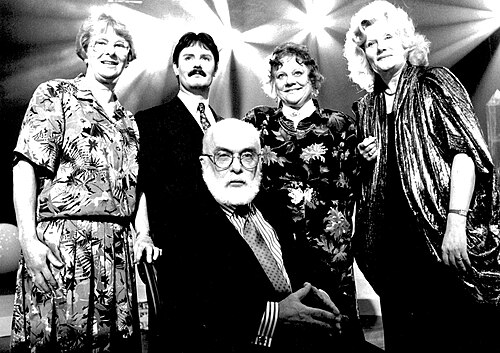
For decades, James Randi was the face of skepticism. His career started in an unlikely place—the stages where he would perform as a magician and escape artist during the sixties and seventies. The seventies were a wild time, and many people were looking for alternatives to mainstream thought. Some found such alternatives in the following of psychics, who claimed all sorts of abilities beyond the reach of ordinary people. Of course, there have always been people who claim abilities that others find extraordinary or impossible. But using the tools of mass communication, were able to reach an audience greater than ever before.
Randi saw these so-called psychics and realized that they were using the same type of trickery that he used in his career as a magician. So he contacted Johnny Carson, and appeared on The Tonight Show opposite Uri Geller. When Randi brought his own props for Geller to demonstrate, rather than the “psychic” using his own, Geller was unable to exhibit any of his claimed abilities.
However, the appearance seemed to backfire. After Carson and Randi debunked Geller’s claims, it only made people believe him more. Randi realized the extent of the influence that such conmen have over their audience, and dedicated a large part of his career to unmasking them.
He did this in a similar manner to how he challenged Geller. He would study the claims of psychic abilities, and determine how to demonstrate a more prosaic explanation. For example, James Hydrick said that he could move the pages of a phonebook with only his mind. Randi, suspecting that Hydrick was blowing on the pages, surrounded the phonebook with lightweight packing peanuts. Suddenly, Hydrick was unable to perform his psychic feats.
Most of the claims that Randi investigated had this same format: an extraordinary claim that can’t be demonstrated when directly confronted.
But this format doesn’t only apply to the world of bending spoons, dowsing for water or reading auras. James Tour is a synthetic chemist who has been extremely critical of modern research into the origins of life. In a debate with YouTube science communicator Dave Farina, the centerpiece of his case was five challenges, involving explanations of how certain biochemical phenomena necessary for life to be generated from matter could occur.
Tour has started to gather an audience, especially among the religious and those skeptical of institutional science. Given his dismissal of their field of study, one would think that the lead researchers in origins of life research would take any opportunity they could to shut him down. This would especially be true if the claims that Farina made in their debate — that Tour is a fraud, a preacher pretending to do science, and someone who consistently lies about the work in the field—were true. So Tour decided to give them the chance.
He repeated the five challenges from his debate, this time to the top ten researchers in the field. If they could answer even one of them, he would take down all of his videos and never publicly speak about the topic again. He even said that they don’t need an impartial judge—if three out of the ten scientists he was challenging agreed that the proposed mechanism satisfied the challenge, he would take down his videos. The only requirement was that the explanation had to be given in a public forum, so that the scientific community could judge for itself if the explanation was convincing.
None of the scientists attempted to answer Tour’s challenges. We see the same pattern that we saw in Randi’s psychics: extraordinary claims that can’t actually be demonstrated when challenged. We all understand that when applied to psychics, this pattern suggests that the claimants were conmen—they just wanted to cheat people for their own motives. There is no reason to think that the pattern doesn’t suggest the same thing about the origins of life researchers.
However, origins of life research is not the only field where this applies. Cosmology is full of ad-hoc additions to theories, ignored anomalies and ill-founded generalizations. The idea that consciousness comes from the brain is philosophically suspect and lacks evidence. Whenever the research touches on fundamental questions, there are myriad extraordinary claims that fail when directly challenged.
Yet ideas such as abiogenesis, the Big Bang and the neural origin of consciousness are considered hallmarks of the scientific worldview. So much so that many consider a person who would challenge them to be anti-science. Yet, there are strong scientific cases against each of these ideas. Why do scientists, as well as science communicators and educators, still promote them?
Every worldview worth the name provides an account of the “big questions.” Why are we here? What happened at the beginning? What is life? Any worldview that fails to provide answers to these questions will be considered incomplete. So ideas are not judged according to their evidentiary merit, but instead on how well they conform to the ideology that is defended by institutional science.
To see an example of this, we can look at the different reactions to two theories. One is a recent idea, that spacetime contains a “quantum memory matrix” that records past events and has an effect on future ones. The other idea, a bit older, is that there are information-carrying “morphogenic fields,” that allow biological systems to “learn” how to assemble into complex structures based on similar structures appearing at different points in space and time.
On the one hand, the difference between these two theories are not so great—they both suppose underlying structures that connect widely disparate events. Yet, the scientist who proposed the first is lauded and is still employed as a professor at the University of Leiden, while the one who proposed the second was ridiculed and run out of his job.
Why such different reactions? The reason is because the evidentiary case for the second implies that mental activity might be independent from the underlying biological activity of the brain. Because that idea is antithetical to the ideology of institutional science, it cannot be allowed to be properly discussed. A similar situation occurs in reincarnation research, where evidence is held to an impossibly high standard, while evidence in more orthodox fields of research is given a more charitable reading. So even though there are strong scientific cases against them, ideas like abiogenesis, the Big Bang theory, and other theories that support physicalism are held sacrosanct.
There is a saying that cheaters never win. But in these fields we see the opposite. Those who are cheating their followers by claiming to do or understand things that they cannot possibly demonstrate have the immense power of institutional science in their corner. This allows them to promulgate the ideology with little impediment.
When a political pundit speaks, we take whatever he says with a grain of salt, knowing that it is tinged with ideology. When a psychic, such as those debunked by Randi, gives ad-hoc justification for why his powers suddenly failed, we recognize it as a bad excuse. Scientists who try to sell us convenient fables that fail evidentiary tests should be treated with the same suspicion.
Leave a Reply